





Basic Policy
The Pigeon Group DNA and the Pigeon Way
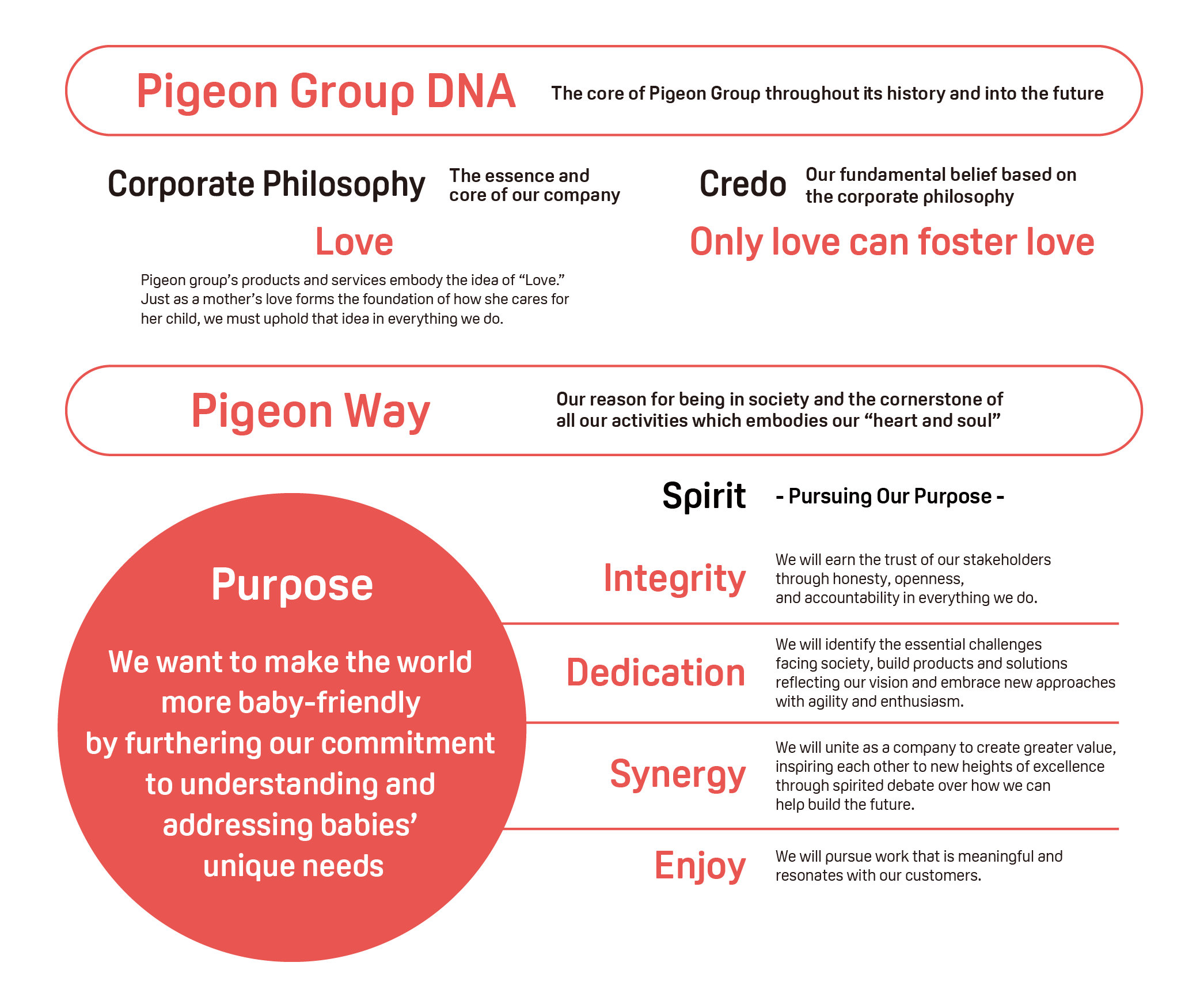
The Pigeon Group DNA consists of our Corporate Philosophy of “Love” and Credo of “Only love can foster love” and has constituted the core of the Pigeon Group throughout its history and will remain so into the future.
The Pigeon Way consists of our Purpose of “We want to make the world more baby-friendly by furthering our commitment to understanding and addressing babies’ unique needs,” along with our Spirit encompassing the notions of “Integrity,” “Dedication,” “Synergy,” and “Enjoy,” thereby constituting the meaning of our reason for being in society and the cornerstone of all our activities which embodies our “heart and soul.” We have positioned our Corporate Philosophy and Credo as the “Pigeon Group DNA,” which is a concept common to the Pigeon Group, and we have positioned our Purpose as the axis of the Pigeon Way to drive our business activities toward its realization. The Pigeon Group DNA and the Pigeon Way are defined as follows.
Establishment of Materiality (Key Issues)
The Pigeon Group’s “Purpose” cannot be realized solely through the efforts of Pigeon Group employees, but can only be realized through collaboration with external stakeholders, including customers, business partners, shareholders, and local communities. We believe that by realizing our “Purpose,” we can not only continue to exist and be recognized as an “indispensable presence in society,” but also contribute to the realization of a sustainable society.
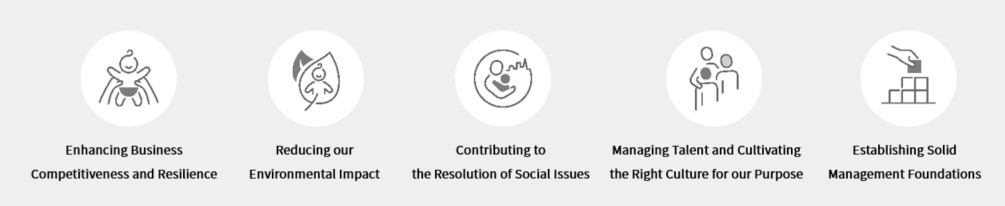
Therefore, the Pigeon Group has established the following five Key Issues to serve as priorities in its efforts to realize its “Purpose.”
Pigeon's Basic Policy of Corporate Governance
Our corporate governance must be in line with the Pigeon Group DNA and the Pigeon Way, be directed toward solving and realizing Key Issues, contribute to the creation and realization of a sustainable society, and ultimately be directed toward realizing our “Purpose” of “We want to make the world more baby-friendly by furthering our commitment to understanding and addressing babies’ unique needs.”
Based on this Policy, we have defined corporate governance as follows: (1) Offensive governance—a mechanism for transparent, fair, prompt, and decisive decision-making to ensure the Pigeon Group’s sustainable growth and medium- to long-term enhancement of corporate value (social value and economic value), the resolution and realization of Key Issues, and the realization of our “Purpose,” and (2) Defensive governance—a mechanism for risk control through the timely collection and sharing of information and examination and verification, in order to prevent or promptly eliminate factors that may impede the Pigeon Group’s sustainable growth, damage corporate value, or impede the resolution and realization of Key Issues or the realization of our “Purpose.”
By continuously strengthening these mechanisms, the Company aims to further enhance corporate governance, increase corporate value, and ultimately contribute to the creation and realization of a sustainable society, as well as realize our “Purpose.”
Corporate Governance Organization Chart
Outline of the Governance System
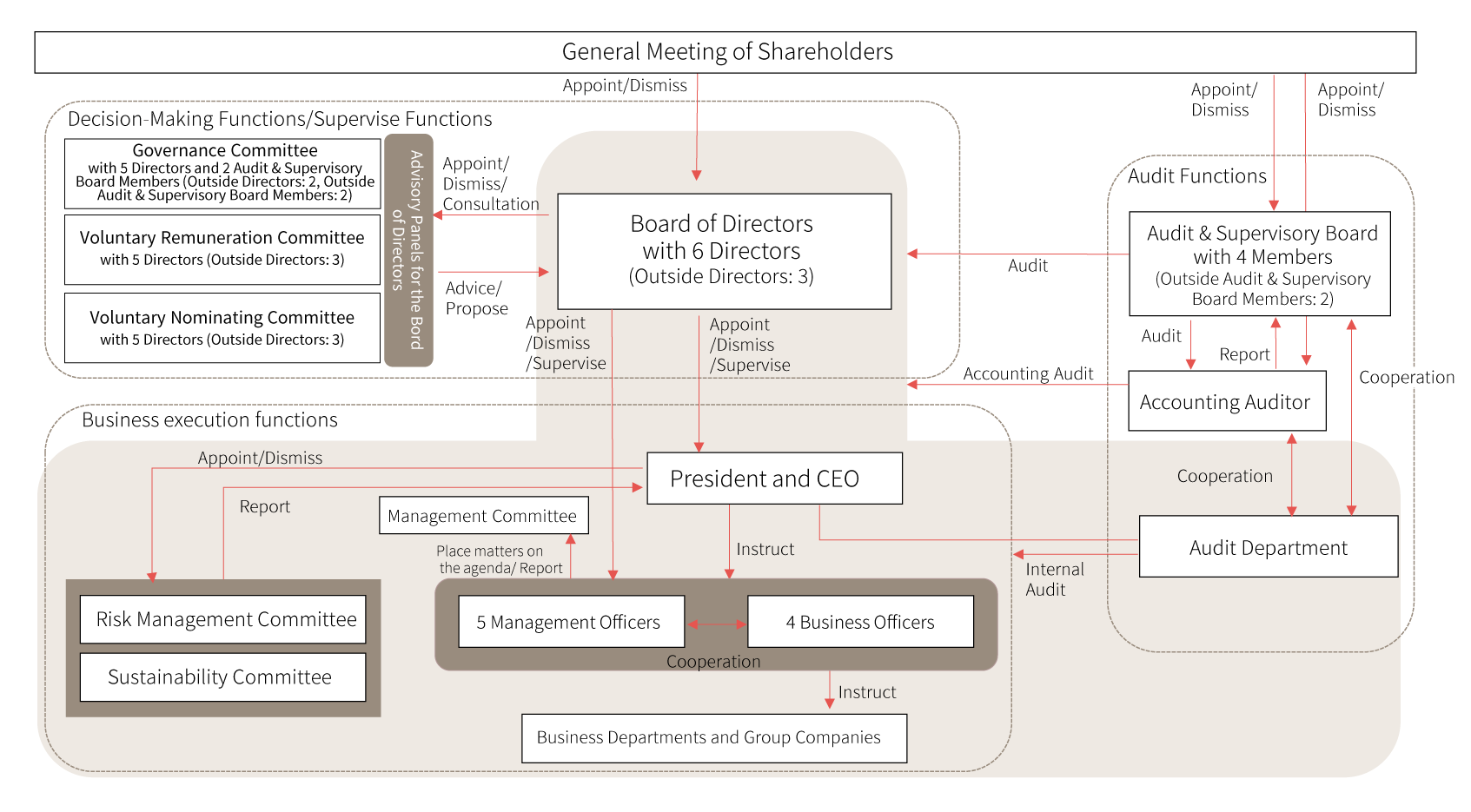
The Company adopts the system of a company with Audit & Supervisory Board Members and has made rigorous legal audits by Audit & Supervisory Board Members the basis of compliance management. The primary management structures (meeting bodies) are: The Board of Directors comprised of 6 members (five men, one woman; six Japanese nationals) including three Independent Outside Directors; the Audit & Supervisory Board comprised of four members (three men, one woman; four Japanese nationals) including two Outside Audit & Supervisory Board Members; Management Committee headed by the President and CEO and comprised of the President and CEO and directors and Group Executive Officers appointed by the President and CEO. The Company is working to enhance the diversity of each of the meeting bodies. In addition, the Company has appointed seven Group Executive Officers. Along with the two Executive Directors, they are positioned directly under the President and CEO as Management Officers (five members) or Business Officers (four members). This structure enables the Company to execute key functional strategies—such as Product & Supply Chain Strategy, Management Strategy, Finance Strategy, Human Resources & Sustainability Strategy, and Brand Strategy— on a global and cross-division basis, thereby establishing a more efficient and advanced management foundation and driving business growth.
The Board of Directors makes decisions on matters (management objectives and important business-execution strategies such as the management strategy) prescribed in laws and regulations, the articles of incorporation, and the “Board of Directors Rules” based on its authority to supervise the execution of duties of directors and managing officers. The Board of Directors actively elicits the opinions of Outside Directors and Audit & Supervisory Board Members, and the supervisory function of the Board of Directors has been further strengthened by having an Independent Outside Director serve as Chairman of the Board from March 2023. Further, apart from Board meetings, we hold a meeting on future strategies biannually to eliminate information asymmetry among Directors and Audit & Supervisory Board Members and for them to discuss the Group’s management issues and strategies from a medium- to long-term viewpoint. Also, in addition to the Voluntary Nominating and Remuneration Committees chaired by and with a majority consisting of Independent Outside Directors, we established the Governance Committee as an advisory panel to the Board of Directors. The Governance Committee is headed by an Independent Outside Director and is comprised of a majority of Outside Directors and Audit & Supervisory Board Members.
Audit & Supervisory Board Members attend meetings of both the Board of Directors and the Management Committee, where they deploy their experience in the field to swiftly resolve issues. In addition to enhancing the supervisory function through expression of opinions and the like, Audit & Supervisory Board Members listen to directors, view important resolution documents, examine the current status of business and financial assets, and otherwise conduct meticulous supervision and oversight particularly in accordance with audit policy and segregation of duties. They also meet regularly with the President and CEO, receive reports on matters such as important company issues, and carry out frank exchanges of opinions.
Under the current management structure, centered on the Board of Directors and Audit & Supervisory Board, the Company has been working to improve corporate governance by expanding the diversity of the Board of Directors through the appointment and increase of Outside Directors since 2015, strengthening the supervisory function of the Board of Directors by appointing an Outside Director as the Chairman of the Board from March 2023, establishing advisory panels to the Board of Directors, and active demonstration of supervisory functions by Audit & Supervisory Board Members.
Scope of Judgments and Decisions by the Board of Directors
The Company’s Board of Directors makes decisions or reports on matters that are to be solely determined by the Board of Directors, pursuant to laws and regulations and the Articles of Incorporation, as well as important matters stipulated in the “Board of Directors Rules.” The “Board of Directors Rules” and other internal rules specifically stipulate matters to be resolved by the Board of Directors and matters to be reported thereto.
Related Party Transactions
The Company believes that the monitoring of conflicts of interest is a typical role and function expected of Outside Directors. The Company directly confirms with the Directors and Audit & Supervisory Board Members every six months the existence of important transactions between the Company and its major shareholders, competing transactions between the Company and its Directors or Audit & Supervisory Board Members, conflict-of-interest transactions (self-dealing and indirect transactions) as well as related party transactions, and reports the results to the Board of Directors. In addition, the “Board of Directors Rules” stipulate that a resolution of the Board of Directors is required when engaging in such transactions.
Directors and Management Officers
List of Directors and Management Officers
Skill Competency Matrix
| Name | Position | Common qualities | Expertise demanded of the Board of Directors(*) | Committee members ◎chair 〇member |
||||||||||||
|---|---|---|---|---|---|---|---|---|---|---|---|---|---|---|---|---|
| Alignment with the Company Purpose | Contrib utions to social impact |
Management and business strategies |
Experience in the Company, industry |
Global business |
Design, R&D, product development |
Supply Chain Management |
Marketing, branding | Human resource development, corporate culture |
Finance and accounting |
Legal affairs, compliance, and risk management |
Nominating | Renumeration | Governance | |||
| Directors | Ryo Yano | President and CEO | 〇 | 〇 | 〇 | 〇 | 〇 | 〇 | 〇 | 〇 | 〇 | 〇 | ||||
| Tadashi Itakura | Director, Senior Managing Executive Officer | 〇 | 〇 | 〇 | 〇 | 〇 | 〇 | 〇 | 〇 | 〇 | 〇 | 〇 | 〇 | |||
| Nobuo Takubo | Director, Junior Managing Executive Officer | 〇 | 〇 | 〇 | 〇 | 〇 | 〇 | 〇 | 〇 | |||||||
| Rehito Hatoyama | Outside Director and Chairman of the Board | 〇 | 〇 | 〇 | 〇 | 〇 | 〇 | 〇 | 〇 | 〇 | 〇 | |||||
| Yumiko Miwa | Outside Director | 〇 | 〇 | 〇 | 〇 | 〇 | ◎ | ◎ | ||||||||
| Hidenori Nagaoka | Outside Director | 〇 | 〇 | 〇 | 〇 | 〇 | 〇 | 〇 | 〇 | ◎ | ||||||
| Audit & Supervisory Board Members | Koji Ishigami | Standing Audit & Supervisory Board Member | 〇 | 〇 | 〇 | 〇 | 〇 | |||||||||
| Kazuyuki Tajima | Standing Audit & Supervisory Board Member | 〇 | 〇 | 〇 | 〇 | 〇 | 〇 | |||||||||
| Koichi Otsu | Outside Audit & Supervisory Board Member | 〇 | 〇 | 〇 | 〇 | 〇 | ||||||||||
| Atsuko Taishido | Outside Audit & Supervisory Board Member | 〇 | 〇 | 〇 | 〇 | 〇 | 〇 | |||||||||
(*) Directors and Audit & Supervisory Board Members are required to possess common qualities, abundant relevant experience and specialized knowledge in their respective areas of expertise, in order to realize our value creation story.
(*) The table lists the primary areas of expertise of each individual.
Independence Standards and Qualification for Independent Directors
Directors and Audit & Supervisory Board Members also serving as directors, Audit & Supervisory Board Member, and management at other companies
The Company discloses the notable concurrent positions of Directors and Audit & Supervisory Board Members, including Outside Directors and Outside Audit & Supervisory Board Members, in the convocation notice of the Ordinary General Meeting of Shareholders each year and the annual securities report. No limit on the number of concurrent positions allowed is formally set, since the practical manner in which each individual is involved in the roles and responsibilities of a Director or Audit & Supervisory Board Member of the Company is more important. The Company instead indicates the number of meetings of the Board of Directors to be held each year in advance, and schedules the meetings so that members are able to attend.
For specific information on the status of concurrent positions, please click here.
Members and Attendance Status of Board of Directors, Board of Audit & Supervisory, and Committees
Evaluating the Effectiveness of the Board of Directors
The Company conducts an annual evaluation of the effectiveness of the Board of Directors in order to strengthen it and improve its governance.
Regarding the effectiveness evaluation and analysis methods implemented in FY2025
【Implementation period】Oct. to Nov. 2025
【Respondents】Directors and Audit & Supervisory Board Members (total 12 people)

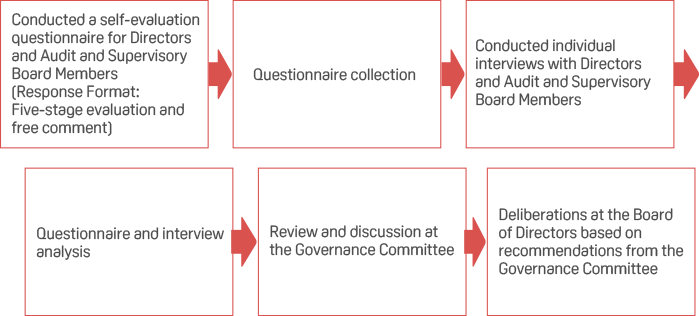
【Questionnaire items】
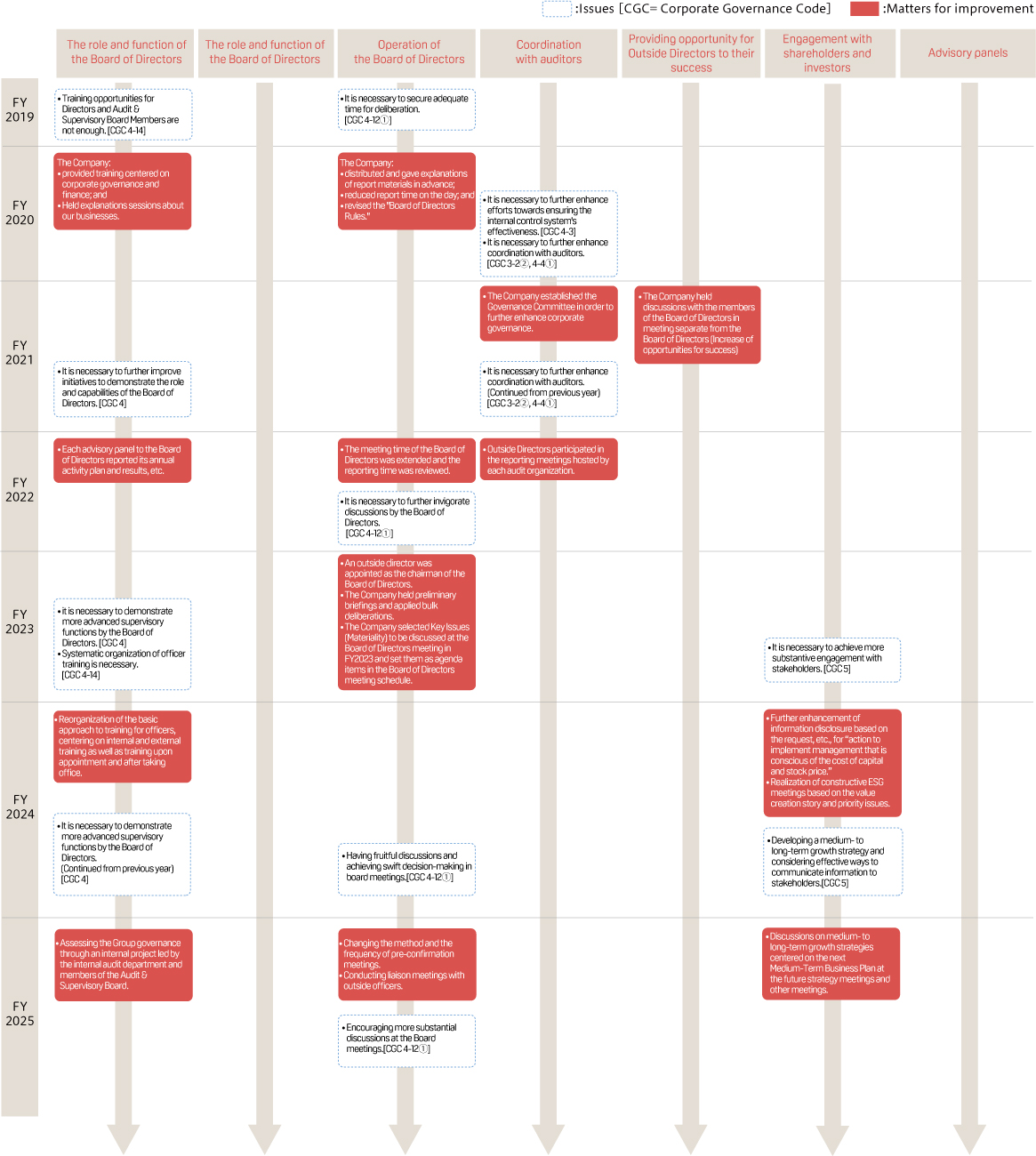
Issues from FY2024 and measures taken, FY2025 assessment results and issues, and future measures
|
Issues identified based on the FY2024 assessment results |
Measures taken in FY2025 |
|
Developing a medium- to long-term growth strategy and considering effective ways to communicate information to stakeholders |
Discussions on medium- to long-term growth strategies centered on the next Medium-Term Business Plan at the future strategy meetings and other meetings |
| Demonstrating a more advanced supervisory function by the Board of Directors | |
| Assessing the Group governance through an internal project led by the internal audit department and members of the Audit & Supervisory Board | |
| Having fruitful discussions and achieving swift decision-making in board meetings | Changing the method and the frequency of pre-confirmation meetings, and conducting liaison meetings with outside officers |

| FY2025 assessment results | |
|---|---|
|
|
Issues identified based on FY2025 assessment results |
Policy for measures to be taken in the future (FY2026) |
| Encouraging more substantial discussions at the Board meetings |
|
Initiatives to enhance the effectiveness of the Board of Directors

Training for Directors and Audit & Supervisory Board Members
All Directors and Audit &Supervisory Board Members will make ceaseless efforts to fulfill their expected roles as Directors and Audit &Supervisory Board Members, and the Company helps them further develop and improve their abilities through the following training support measures.
|
At the time of inauguration |
After inauguration | ||
|---|---|---|---|
|
Directors |
Inside |
Encourage them to participate in external training that will help them deepen the knowledge and understanding generally required of officers for the solution of issues related to management, compliance, corporate governance and others |
(1) Help them deepen their understanding of the Pigeon Group and its businesses through practical training and site visits (2) Provide information and hold training sessions, and also encourage them to participate in external training, with a view to helping them solve managerial issues and deepen their understanding about general situations concerning economy, society, compliance, corporate governance and others |
|
Outside |
(1) Encourage them to participate in external training that will help them deepen the knowledge and understanding generally required of officers for the solution of issues related to management, compliance, corporate governance and others (2) Provide information and have the staff in charge of each business make explanations to help them deepen their understanding of the Pigeon Group and its businesses |
||
|
Audit &Supervisory Board Members |
Inside |
Encourage them to participate in external training that will help them deepen the knowledge and understanding generally required of officers for the solution of issues related to management, compliance, corporate governance and others |
|
|
Outside |
Provide information and have the staff in charge of each business make explanations to help them deepen their understanding of the Pigeon Group and its businesses |
||
Governance Committee
To further strengthen corporate governance in the Pigeon Group, we established the Governance Committee as an advisory panel to the Board of Directors, chaired by an Independent Outside Director and with a majority of its members being Outside Directors and Outside Audit & Supervisory Board Members. The Committee deliberates on various issues related to corporate governance within the Group that have been identified through the evaluation of the effectiveness of the Board of Directors, etc., from the perspective of promoting organic coordination and integration and proactive implementation, and provides advice and recommendations to the Board of Directors. During the current fiscal year, we conducted reviews of future strategy meeting themes, examined the operation of the Board of Directors, implemented and reviewed group governance evaluations, updated the long list of governance-related issues, and conducted an assessment of the effectiveness of the Board of Directors.
Election, dismissal, nomination and remuneration of Directors and Audit & Supervisory Board Members
In order to ensure a high degree of independence, objectivity, and transparency in the decision-making process for the selection, dismissal, and nomination of Directors and in the design and operation of the executive remuneration system, the Company established a Voluntary Nominating Committee and Remuneration Committee as advisory panels to the Board of Directors. In addition, we believe that it is important to have a system that reflects the opinions and intentions of Independent Outside Directors by having a majority of the committee members consisting of Independent Outside Directors and by having the committee deliberate in an advisory panel independent of the Board of Directors, prior to decisions by the Board of Directors regarding the nomination of Director candidates and compensation of individual Directors, in order to exercise appropriate supervision over individual Directors and the Board of Directors. Based on this concept, the Voluntary Nominating Committee and Remuneration Committee are composed of at least five members, the majority of whom are Independent Outside Directors. In addition, the members of both committees are determined by resolution of the Board of Directors, and the chairpersons of the committees are nominated from among the committees’ members who are Independent Outside Directors and determined by resolution of the committees. The Voluntary Nominating Committee and Remuneration Committee deliberate in consultation with the Board of Directors and provide advice and recommendations to the Board of Directors.
Voluntary Remuneration Committee, Executive Remuneration System
In order to increase the independence, objectivity, and transparency of the executive remuneration system, the Company has established a Voluntary Remuneration Committee as an advisory panel to the Board of Directors. The chairman and the majority of members of the committee are Independent Outside Directors. The Voluntary Remuneration Committee provides advice and proposals to the Board of Directors upon having deliberated on matters that include: governance of executive remuneration; whether it is necessary to revise the executive remuneration policy; remuneration levels of individual executives (base amount by position); performance targets and evaluation table for bonuses and stock remuneration; performance evaluations and individual payment amounts for bonuses and stock remuneration in the previous fiscal year; status of initiatives of the Medium-Term Business Plan and the Key Issues; factors such as level, composition and indicators of executive remuneration using external data and other research; the necessity of response to executive remuneration due to changes in the external environment and business environment; and improving the effectiveness of the Voluntary Remuneration Committee. During the fiscal year under review, the Committee examined revisions to the executive remuneration policy based on the next Medium-Term Business Plan; confirmed performance targets and evaluation table for bonuses and stock remuneration; confirmed matters such as performance evaluations and individual payment amounts for bonuses, and stock remuneration in the previous fiscal year; confirmed progress associated with indicators of Key Issues for bonuses and stock remuneration; confirmed factors such as level, composition and indicators of executive remuneration using external data and other research; and examined improvements of the effectiveness of the Voluntary Remuneration Committee.
The remuneration for the Company's Directors (excluding Independent Outside Directors) consists of "basic remuneration" commensurate with position, "bonuses" provided as short-term incentives, and "stock remuneration" provided as a medium- to long-term incentive. The remuneration for Independent Outside Directors and Audit & Supervisory Board Members consists of "basic remuneration" only.
Please note that executive remuneration, etc. will be paid within the limit of remuneration adopted at the General Meeting of Shareholders.
The Company has already abolished the retirement benefits system for Directors.
The targets and results of the performance-linked remuneration indicators for the current fiscal year are as follows:
【Targets and actual results of performance indicators for performance-linked bonuses】
|
Category |
Weight |
Target |
Actual |
Achievement Rate* |
Performance | |
|---|---|---|---|---|---|---|
|
Consolidated |
Net Sales |
40% |
109,700 |
109,700 |
100% |
100% |
|
Operating Profit |
30% |
12,900 |
13,158 |
102% |
105% |
|
|
PVA |
20% |
4,918 |
4,948 |
101% |
103% |
|
| Material Issues |
Increase in wide-neck |
5% |
**35% |
36% |
103% |
103% |
|
Maintain/Improve ESG scores |
5% |
FTSE 3.9 and more MSCI AA and more |
FTSE 4.3 MSCI AA |
- |
150% |
|
*Rounded to the nearest whole number
**Total of three countries: Middle East, Indonesia, and India
【Targets and actual results of performance indicators for performance-linked stock compensation】
|
Category |
Weight |
Target |
Actual |
Achievement Rate |
Performance Coefficient | |
|---|---|---|---|---|---|---|
|
Consolidated Performance |
EPS Growth Rate |
30% |
21.19% |
△0.10% |
△0.50% |
0.00% |
|
TSR (Relative Comparison) * |
30% |
- |
7/9th |
- |
75.00% |
|
|
ROIC |
20% |
15.1% |
10.8% |
71.50% |
71.50% |
|
| Material Issues |
Pigeon Green Action Plan |
5% |
Target values set by each SBU |
100% |
100% |
90.00% |
|
Diverse support and awareness-raising activities for childcare |
5% |
Target values set by each SBU |
100% |
100% |
||
|
Improvement of employee engagement |
10% |
Score for 3 items related to Purpose realization: +0.1 vs. 2023 |
0.08 |
80% |
||
*TSR is evaluated based on its ranking relative to a peer group of nine companies.
Voluntary Nominating Committee, Executive Nomination Process
The Company has established a Voluntary Nominating Committee as an advisory panel to the Board of Directors to enhance the independence, objectivity, and transparency of the appointment/dismissal and nomination processes for Directors. The chairman and the majority of members of the committee are Independent Outside Directors. The Voluntary Nominating Committee deliberates on the appointment/dismissal criteria for Directors and the successor plan for Chief Executive Officer (CEO), etc., and provides advice and proposals to the Board of Directors. During the fiscal year under review, the Committee examined revisions to the Executive Nomination Policy; verified and implemented the CEO successor plan; examined candidates for Directors; reviewed the term of office and tenure of Directors; reviewed revisions to the skill matrix; examined the formulation of a successor plan for Outside Directors;strengthened information coordination between the Board of Directors and the Governance Committee; and examined improvements of the effectiveness of the Voluntary Nominating Committee. In addition, the Voluntary Nominating Committee deliberates on draft proposals, and upon resolution by the Board of Directors, the Company formulates its Executive Nomination Policy. The personnel requirements for the CEO and the appointment/dismissal criteria for Directors and the CEO have been established in the Executive Nomination Policy. The ideal human qualities necessary for the role of CEO of the Company are “Human qualities that can enhance resourcefulness and continuously increase the Company’s corporate value (social and economic value), based on the values of the Pigeon Group DNA and Pigeon Way.” In addition, the detailed human resource requirements are determined in terms of responsibility and authority, main duties and expected results, and required competencies (behavioral characteristics, personality characteristics, experience and achievements, knowledge and skills). Furthermore, the dismissal criteria for Directors and the CEO are provided below.
1) Where corrupt, unjust, or disloyal actions are suspected
2) Where a lack of qualifications is recognized, such as a legal violation
3) Where the process or results of the execution of duties is insufficient, or where it is deemed inappropriate to have the individual continue to perform duties
4) Where ROE has fallen below 5% for three (3) consecutive fiscal years (only for the CEO)
Policy and Procedures for nominating candidates for Audit & Supervisory Board Members
Candidates for Audit & Supervisory Board Members are nominated by the Board of Directors and deliberated by the Audit & Supervisory Board. After obtaining the consent of the Audit & Supervisory Board, they are proposed for election by the General Meeting of Shareholders. For Outside Audit & Supervisory Board Members, individuals with high perception of corporate activities such as finance and law shall be nominated as candidates. The majority of these individuals shall be CPAs and lawyers.
*Regarding individual reasons for the election of Directors and Audit & Supervisory Board Members, please refer to the Notice of the Ordinary General Meeting of Shareholders. If a senior management is dismissed, the Company shall disclose the dismissal in a timely and appropriate manner.
Internal Controls
We have established a basic policy on the construction of its internal control systems, based on the Companies Act and its enforcement regulations. The purpose of this basic policy is to ensure the sound and efficient operation of our organizations. Based on this policy, we maintain and operate an internal control system governing the entire group.
Internal Audit
Purpose and Roles
The purpose of our internal audit is to enhance the group companies' ability to create, secure, and conserve value. It serves the following two roles:
1.Assurance: To assess the status of compliance and organizational operations, identify issues, and propose corrective actions.
2.Advisory: To provide forward-looking strategic advice and proposals for organization-wide optimization.
Internal Audit Structure and Coordination
We have an independent Internal Audit department ―comprising nine staff*― that reports directly to the President and CEO. The department closely coordinates with the Audit & Supervisory Board Members and Accounting Auditors by sharing information on a regular and required basis and conducting joint investigations and verifications as necessary. It also works closely with second-line functions such as Legal, Accounting & Finance, and Risk Management to ensure efficient and robust monitoring and supervision over the group companies and their departments.
※As of March 2026
Internal Audit Scope
The Internal Audit department audits all offices and departments of our domestic and overseas group companies, including the headquarters. Pursuing the above purpose, the scope of internal audits covers all aspects of management and operations of the organization and business, including:
1.Governance, risk management, and internal controls
2.Objectives, strategies, plans, and results of the business units, departments, and projects
3.Organizational culture, including corporate ethics
Internal Audit Practices
The Internal Audit department develops a risk-based internal audit plan annually, which the Board of Directors approves. For each engagement, the department issues an audit report to all members of the Board of Directors and the Audit & Supervisory Board (hereafter "senior executives"). We also hold an oral debriefing session per engagement with the internal auditors and the senior executives to discuss the issues and measures in depth. Based on the report and discussion, the senior executives provide instructions and advice for the auditee, and the auditee submits corrective action plans as the response. The Internal Audit Department determines the necessity of follow-up in order to confirm the status of corrective actions and the resolution of issues. When deemed necessary, the department establishes follow-up methods, monitors the progress and effectiveness of corrective actions, and runs the PDCA cycle.
The Internal Audit department also plays a key role in J-SOX compliance. The department assesses the company-wide internal controls and financial reporting processes according to the internal control framework plan for financial reporting under the Financial Instruments and Exchange Act. In the fiscal year ended December 2025, the Internal Audit department assessed the internal controls of the headquarters and ten group companies in terms of the installment status and the operation appropriateness, the results of which have been issued as the Internal Control Report together with the Securities Report after undergoing an internal control audit by the external auditor.
Policy on Strategic Shareholdings
Basic Policy
The Company may hold shares as strategic shareholdings, with the aim of improving relations and collaboration with business partners. However, as of the submission date of this report, the Company holds only one stock listed overseas as a strategic shareholding. The Company discloses the purpose and holding status of this strategic shareholding in the annual securities report. Regarding individual strategic shareholdings, the Company confirms the background and objectives of holding the shares, the status of transactions, and risks associated with holding the shares, etc. The Company reviews whether or not shares can continue to be held each year, as well as the number of shares to hold, and obtains approval for strategic shareholdings by the Board of Directors, as a disclosure item of the annual securities report.
Exercises voting rights
The Company exercises voting rights for strategic shareholdings after considering proposals from the perspective of improving the corporate value of the Pigeon Group, while paying due respect to the management policy of the company it invests in.