




Pigeon Green Action Plan
- Home
- Sustainability
- Environment
- Pigeon Green Action Plan

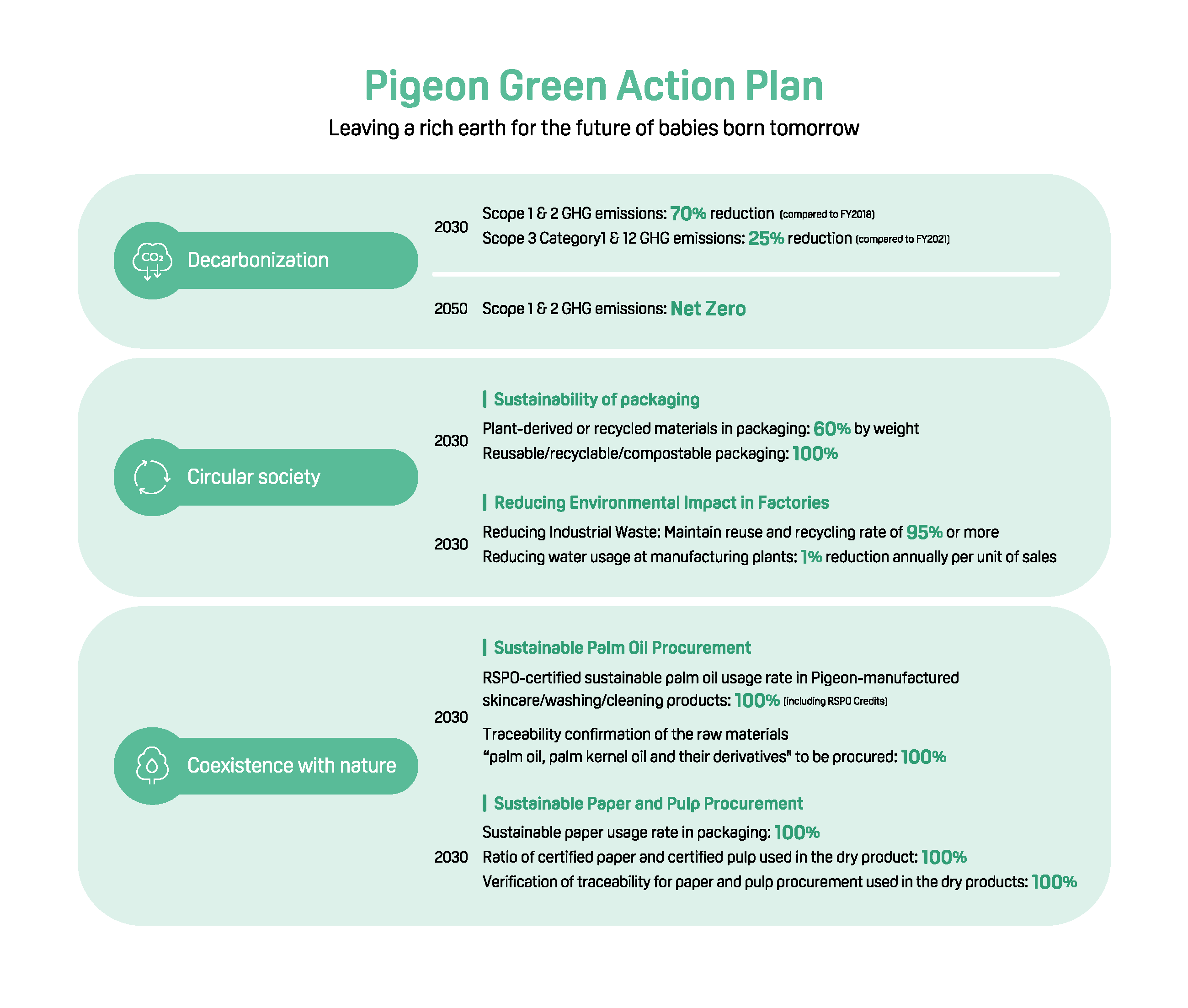
Pigeon Formulates the Pigeon Green Action Plan to leave a rich Earth for the future of babies born tomorrow in 2022.
Under the Pigeon Green Action Plan, the Pigeon Group will focus on resolving the climate change issue, the plastics issue, and declining biodiversity, all of which are particularly relevant to the Group’s business activities, and strive to reduce its environmental impacts by setting medium- to long-term targets toward decarbonization, a circular society, and coexistence with nature.
In 2026, we expanded and updated the specific targets within the Pigeon Green Action Plan to enhance the effectiveness of our initiatives addressing social issues and to ensure steady progress.
Decarbonization
The Pigeon Group‘s 2030 greenhouse gas (GHG) emission reduction targets validated for its near-term science-based targets (SBT) from the SBTi*.
* The SBTi is an international climate change initiative jointly established by the United Nations Global Compact, CDP (an international NGO tackling climate change and related issues), WRI (World Resources Institute), and WWF (World Wide Fund for Nature). And SBTi promotes companies to set science-based greenhouse gas emission reduction targets in order to achieve the Paris Agreement goals.
Pigeon group’s greenhouse gas emission reduction targets validated from the SBTi
| 2030 | Scope 1 & 2 GHG emissions: 70% reduction (compared to FY2018) Scope 3 Category1 & 12 GHG emissions: 25% reduction (compared to FY2021) |
|---|
*1 Scope 1 refers to direct greenhouse gas emissions from in-house fuel use, etc., and Scope 2 refers to indirect greenhouse gas emissions from purchased electricity and heat.
*2 Scope 3 refers to indirect emissions other than Scope 1 and Scope 2; Category 1 refers to emissions associated with purchased products and services, and Category 12 refers to emissions associated with the disposal of sold products.
By 2030, the Pigeon Group will reduce its Scope 1 & 2 greenhouse gas emissions by 70% (compared to FY2018) and promote initiatives such as installing solar panels, purchasing renewable energy (electricity), and reducing its energy use by switching to LED lighting and making other energy-saving changes at its facilities. The Pigeon Group also aims to reduce Category 1 and Category 12 GHG emissions, which are our largest sources of Scope 3 GHG emissions, by 25% by 2030 (compared to FY2021.
The Pigeon Group will promote initiatives to achieve Scope 1 & 2 GHG emissions net zero by 2050.
Circular society
Sustainability of packaging
Global plastic production continues to increase, and much of the Pigeon Group’s product packaging uses plastic as well. In order to achieve a sustainable society, The Pigeon Group promotes "circular monozukuri (manufacturing)" with full consideration for the future environment of childcare and the global environment.
To accelerate these efforts, we have revised our target for the use of plant-derived or recycled materials in packaging, increasing it from 50% to a 60% (by weight) target for 2030. Additionally, by the same year, all of the Pigeon Group's packaging will be reusable, recyclable, and/or compostable by design.
2030 Targets
| Plant-derived or recycled materials in packaging: 60% by weight |
| Reusable/recyclable/compostable packaging: 100% |
Reducing Environmental Impact in Factories
By promoting "Circular Monozukuri (Manufacturing)," we aim to minimize waste and maximize resource efficiency in our production processes—a mission central to ensuring a better planet for future generations. Along with reducing waste at the source, we maintain high reuse and recycling rate. At the same time, recognizing that water is the source of all life and essential for a safe childcare environment, the Pigeon Group is committed to reducing water usage and waste. By protecting Earth's limited resources and building a sustainable society, we will preserve a rich and healthy environment for the babies born tomorrow and beyond.
2030 Targets
| Reducing Industrial Waste:Maintain reuse and recycling rate of 95% or more |
| Reducing water usage at manufacturing plants:1%reduction annually per unit of sales |
Coexistence with nature
Sustainable Palm Oil Procurement
Due to illegal tree felling and other factors, the world’s forested surface is shrinking. Destroying forests not only robs living beings of their homes, it has a major impact on natural hazards caused by water and soil degradation as well as climate change.
The skincare, washing, and cleaning products manufactured and sold by the Pigeon Group include components manufactured from palm oil and palm kernel oil among their raw materials. To encourage the sustainable use of palm oil, in December 2020 Pigeon became an ordinary member of the Roundtable on Sustainable Palm Oil (RSPO), an NPO established to help conserve tropical rainforests and biodiversity by promoting the production and use of sustainable palm oil. The Pigeon Group promotes the use of RSPO-certified sustainable palm oil in its skincare, laundry, and cleaning products. Furthermore, for raw materials (palm oil, palm kernel oil, and their derivatives) procured for internal production, we strive for traceability back to the oil mill and are committed to the responsible procurement of palm oil derivatives*1.
2030 Targets
| RSPO-certified sustainable palm oil usage rate in Pigeon-manufactured skincare/washing/cleaning products: 100%(including RSPO Credits)*2 |
| Traceability confirmation of the raw materials “palm oil, palm kernel oil and their derivatives" to be procured: 100% |
*1 Palm oil derivatives: Products using components manufactured with palm oil or palm kernel oil as raw ingredients.
*2 The book and claim (B&C) method supports certified palm (kernel) oil production by allowing end users to purchase credits issued based on the amount of palm (kernel) oil produced by RSPO-certified producers.
Sustainable Paper and Pulp Procurement
To realize a nature-positive society (a society in harmony with nature), the Pigeon Group promotes the use of certified paper and recycled paper sourced from responsibly managed forests. In response to the growing social demand for sustainability in packaging, we are expanding our commitment beyond packaging to include the use of certified paper and pulp in our dry products*3, while ensuring full traceability. By pursuing transparency and sustainability in raw material procurement, we strive to protect the natural environment and foster biodiversity, providing products that our customers can choose with confidence and peace of mind.
2030 Targets
| Sustainable paper usage rate in packaging: 100% |
| Ratio of certified paper and certified pulp used in the dry product *3 : 100% |
| Verification of traceability for paper and pulp procurement used in the dry products*3 : 100% |
*3 The dry product is for dry products (breast pads, etc.) pulp, tissue, and release paper.
- Home
- Sustainability
- Environment
- Pigeon Green Action Plan