





Research Fields > Feeding and Breastfeeding
Aiming to Achieve Natural Breast Milk Expression
Research on the Suction Rhythm of Breast Pumps Developed from Sucking Motion Research
Approach for Breast Pump Research and Development
While it is desirable for mothers to breastfeed directly, a variety of circumstances and lifestyles that might include hospitalization of the infant or the mother's return to work, can make direct breastfeeding difficult. Even in situations where direct breastfeeding is difficult, however, breastfeeding can continue by maintaining milk expression through the use of a breast pump and then feeding the expressed breast milk to the infant. To support breastfeeding, Pigeon has continued to support the research and development of breast pumps that can suction a sufficient volume of milk naturally and without strain.

The Importance of Understanding How Infants Are Fed
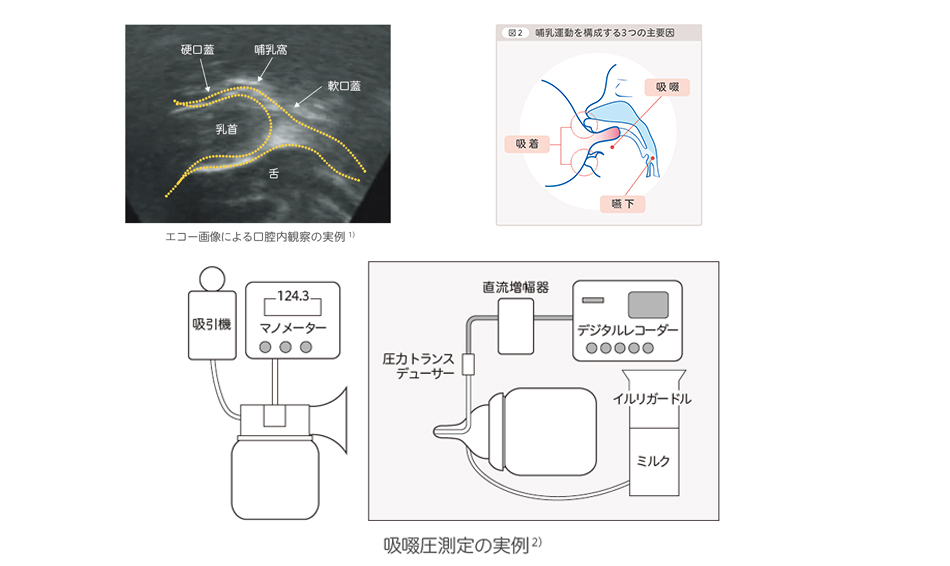
Most people have the strong perception of physically squeezing or sucking when they hear the phrase "milk expression" and thus tend to focus on the suction function of breast pumps. However, breastfeeding is a physiological mechanism established through the interaction between the infant and mother—milk is expressed in response to sucking by the infant (see column for details). Pigeon believes that breast pumps need to replicate the functionality of that physiological effect. In simple terms, the switch for the mother to express breast milk is turned on when the mother's body receives the stimulation caused by the infant sucking. As shown in the diagram below, there are three main switches that the sucking by infants can turn on to establish and maintain breast milk production. According to Pigeon, the challenge in breast pump research is to enable breast pumps to interact with the mother's body in the same way as infants such that these three breast milk expression switches are turned on. That is the reason Pigeon places great importance on understanding the feeding behavior (sucking motion) of infants in the research and development of breast pumps so that breast pumps can provide a similar feeling to natural breastfeeding.

Research on Infant Feeding Behavior (Sucking Motion) and Application in Breast Pumps
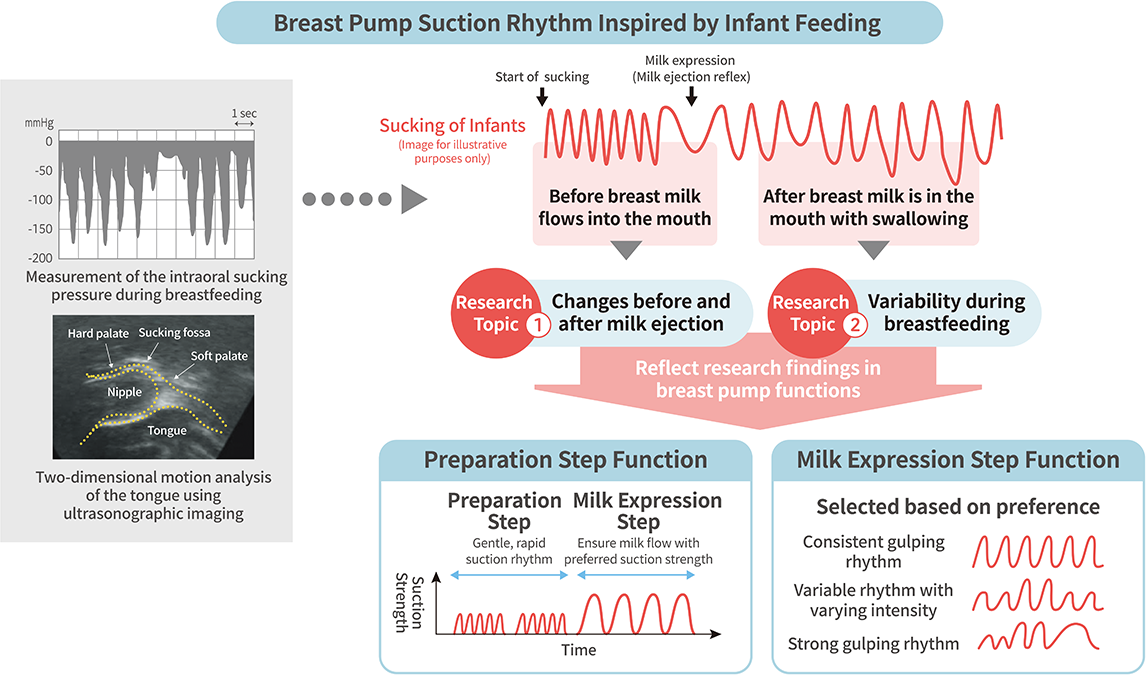
To identify the mechanism of the sucking motion by infants, Pigeon studied the natural feeding behavior of infants using devices to measure intraoral sucking pressure and used ultrasonography (echography) to observe the oral movements of infants. Findings from these research studies have been used in the development of the suction rhythm of breast pumps. The research results are reflected in breast pumps through Pigeon's approach of researching both perspectives of breastfeeding by the mother and sucking by the infant as shown below.
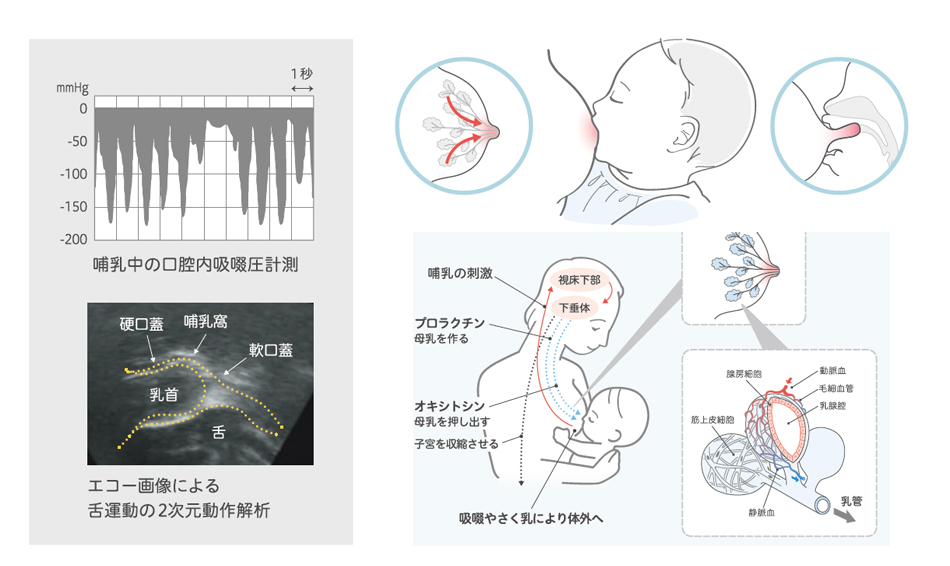
Column: How Breast Milk is Produced: Milk is Expressed in Response to Sucking by the Infant1-4
Breast milk expression requires the release of the hormones prolactin, which produces milk, and oxytocin, which ejects milk. The stimulation from the sucking by the infant is transmitted to the mother and promotes the secretion of these hormones. The stimulation from the sucking by the infant plays a crucial role in establishing and maintaining milk expression. Triggering the milk ejection reflex is important, especially during breastfeeding. The sucking by the infant stimulates the release of oxytocin, which causes the myoepithelial cells surrounding the alveoli to contract and push milk into the lactiferous ducts. This entire process is called the milk ejection reflex. Without the milk ejection reflex, the infant cannot be fed on breast milk, and pumping milk is also impossible.Breastfeeding is often perceived as an action solely by the mother; however, it is actually a physiological mechanism established through the interaction between the infant and mother as milk is expressed because the infant sucks.

Research Topic ①
Changes Before and After Milk Ejection
Sucking by the infant initially involves rapid sucking that triggers milk ejection, which then transitions to sucking accompanied by the swallowing of the ejected breast milk. Research that clarified changes before and after milk ejection led to the development of the preparation step in breast pumps.
Changes in Sucking Pressure Before and After Milk Ejection5
Research Summary
The characteristics of non-nutritive sucking (NNS) observed before milk ejection and nutritive sucking (NS) after milk ejection in direct breastfeeding was investigated through an examination of intraoral sucking pressure. The results showed relatively rapid sucking before milk ejection, followed by a decrease in both sucking speed and pressure after milk ejection, which confirmed the infant’s transition from NNS to NS. Similarly, when milk flow was prevented at the start of bottle-feeding, rapid sucking was also observed. This rapid sucking before milk flow was thought to play a role in triggering the milk ejection reflex at the start of feeding.
Changes in Tongue Movement Before and After Milk Ejection6
Research Summary
Sucking behavior consists of rhythmic movements based on peristaltic tongue movements.7,8 However, when the entire feeding episode from start to finish is observed as a single feeding behavior, the sucking motion alternated between bursts and pauses and involved a combination of patterns of strong sucking and weak sucking.9Therefore, the impact of milk ejection from the mother on infant sucking behavior was observed using ultrasonography (echography) to analyze the tongue movements. The results showed that sucking movements before and after milk ejection could be categorized into four phases (Phase I to Phase IV), and the suggestion was made that the sucking movements with relatively fast, small up-and-down movement of the tongue in Phase I before milk ejection promoted milk ejection.
Research Topic ②
Variability During Breast Pumping
The sucking motion by the infant during feeding is not consistent like a machine but includes pauses and constant changes in the strength and speed of sucking. A variable rhythm for breast pumps was thus developed on the basis of research demonstrating this variability during breastfeeding.
Sucking Variability During Breastfeeding7
Research Summary
The infant’s sucking motion during direct breastfeeding changes before and after the milk ejection reflex (refer to above, “Research Topic ①”). In this research, the characteristics of sucking pressure before and after milk ejection was further investigated by measuring the intraoral sucking pressure. The results showed that before milk ejection, fluctuations in sucking pressure and the intervals (speed) of sucking were relatively small, whereas after milk ejection, there were larger changes in sucking pressure and speed than before milk ejection, indicating greater variability. Furthermore, this variability was not uniform, and different patterns were observed within a single sucking cycle where strong and weak sucking motions coexisted.
Effect of Variable Suction Rhythm During Milk Expression8
Research Summary
The breast pump suction rhythm (variable rhythm) with altering intensity and speed was developed on the basis of the characteristics of sucking variability identified through research. The user experience and milk expression efficiency of this variable rhythm was compared with a breast pump that used a conventional (monotonous) rhythm. The results showed that the majority of mothers preferred the experience of using a pump with a variable rhythm over a pump with a monotonous rhythm. Furthermore, no significant differences were observed between the variable rhythm and monotonous rhythm in milk volume, fat content in the foremilk/hindmilk, or subjective residual milk sensation after 10 minutes of pumping. This research suggested that developing a breast pump with a variable suction rhythm might improve the user experience without compromising pumping effectiveness.
See below for details.
Research Report: “Aiming to Achieve Natural Breast Milk Expression: Research on the Suction Rhythm of Breast Pumps Developed from Sucking Motion Research”
1) Mizuno K, Mizuno N. Anatomy of the Breast on Day 1, Physiology of Breast Milk Secretion on Day 2. Breastfeeding Support Course, Nanzando, Tokyo, 2011: 2-31.
2) De Carvalho M, et al. Effect of frequent breast-feeding on early milk production and infant weight gain. Pediatrics. 1983; 72(3): 307-311.
3) Wambach K, Spencer B. CHAPTER3 Anatomy and Physiology of Lactation, Breastfeeding and Human Lactation. 6th ed. Jones & Bartlett Learning, Burlington MA, 2021 : 49-84.
4) Mizuno K. Chapter 3: Physiology of Breast Milk Secretion. Easy-to-Understand Breastfeeding, Revised 2nd Edition. Health Publishing, Tokyo, 2014: 42-51.
5) Mizuno K, Ueda A. Changes in Sucking Performance from Nonnutritive Sucking to Nutritive Sucking during Breast- and Bottle-Feeding, Pediatr Res. 2006; 59(5): 728-731.
6) Ishimaru A, Saito T. Changes in Sucking Movement Before and After the Development of the Milk Ejection Reflex (Special Feature: The Science of Breast Milk) -- (Breast Milk Secretion). Perinatal Medicine. 2004; 34 (9): 1385-1389.
7) Saitō, T. Changes in Sucking Patterns Before and After Onset of the Milk Ejection Reflex. Maternal and Child Health. 2018; 59 (3) : 210.
8) Kuroishi J, Toyonaga M, Saito S. Characteristics of Milk Expression Using Suction with Variable Rhythms - Part 1: Temporal Changes in Milk Volume and Mother’s User Experience. Maternal and Child Health. 2018; 59(3): 247-247.
Related Information
Research Report
関連記事
- Home
- Research and Development
- Research Fields
- Feeding and Breastfeeding
- Aiming to Achieve Natural Breast Milk ExpressionResearch on the Suction Rhythm of Breast Pumps Developed from Sucking Motion Research