





Research Fields > Feeding and Breastfeeding
Research by Pigeon to elucidate the mechanism of sucking behavior and reproduction of the functions
Pigeon's research on sucking behavior
Breastfeeding by the mother is most appropriate, but some mothers may find it difficult to directly feed their infants with breast milk for a variety of reasons. Even if it is difficult for mothers to directly breastfeed their infants, Pigeon tries to enable safe bottle feeding as needed without interfering with direct breastfeeding and tries to [provide support for sucking by infants who need special care. Thus, Pigeon understands sucking behavior, aims to put the functions that mothers and infants truly need into practical use, and then accumulates new knowledge by consistently initiating new observation methods. Pigeon aims to provide the best method to support the healthy growth of all infants even if breastfeeding is difficult for a variety of different reasons.
Pigeon's sucking research approach
Pigeon aims to elucidate the mechanism of sucking behavior and investigate the function of exactly how infants drink milk. Each movement underlying the sucking behavior is examined with the aim of connecting the key factors of sucking as identified in the research to the development of products and services.
It is difficult to carry out research on infants, including sucking behavior research, because of the need to develop insight into what is behind the behavior demonstrated by infants. First, we need thorough observations to elucidate how infants suck, since they cannot describe their sense of use in words like adults. Thus, we have continued to observe infant's sucking behavior over the 60-year history of the company.
The various behaviors in the oral cavity of infants during sucking and their functions cannot be understood simply through visual observation. So, Pigeon created unique research observational technologies to observe infants, such as through the use of an intraoral observation camera that does not interfere with the behavior of infants, ultrasonography to observe the movement within the oral cavity, and a device to measure the sucking vacuum pressure in the oral cavity (Figure 1).
Using these observational technologies, Pigeon researchers can assess and verify the key factors that enable the sucking behavior and whether Pigeon products can reproduce the sucking behavior of direct breastfeeding while obtaining the cooperation of many specialists, infants, and mothers.
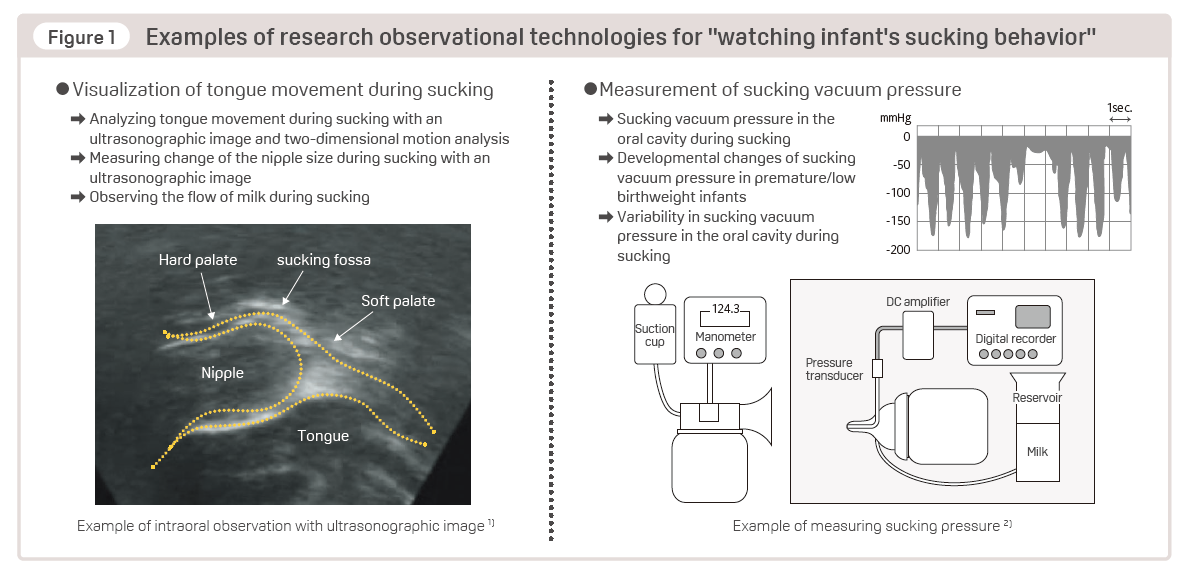
Importance of the three key factors of sucking clarified through 60 years of sucking research
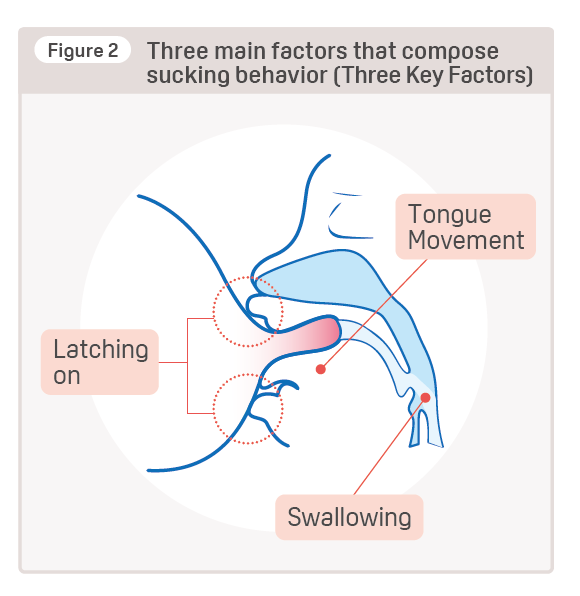
The important factors in sucking behavior clarified through previous research by Pigeon are called the three key factors of sucking and are placed in the center of research and development. They are composed of the sucking behavior as follows
(Figure 2).
Tongue movement: The tongue’s wave-like motion to draw milk into the mouth.
Swallowing: The function to transfer milk down into the esophagus.
The functions necessary for sucking support and the functions that are really necessary for nursing bottles can be found by understanding the sucking behavior of infants based on these three key factors.
Key Points
- In research and development, Pigeon not only develops products but also investigate the sucking behavior of infants mainly based on the three key factors of sucking (latching on, tongue movement, and swallowing).
- For infants who need special care, Pigeon is carrying out research and development that always questions the products that Pigeon should create to support the function and any difficulties in order to help with the breastfeeding of infants by mothers.
See details here
Research Report: Research by Pigeon to elucidate the mechanism of sucking behavior and reproduction of the functions (2021)
Related Information
Research Report
- Research on opening of the lips, depth at latching on, and intraoral position during direct breastfeeding Pursuit of a design that enables appropriate latching on
- Research on the infant sucking behavior and the change of nipple shapes in the oral cavity during sucking Softness that reproduces natural sucking behavior
- Research on the coordinated movement of swallowing and breathing in infancy Searching for milk flow that promotes infant's natural breathing
- Aiming for preterm / low birthweight infants to drink appropriately The research of Pigeon searching for the development of swallowing and breathing of preterm/ low birthweight infants
関連記事
- Home
- Research and Development
- Research Fields
- Feeding and Breastfeeding
- Research by Pigeon to elucidate the mechanism of sucking behavior and reproduction of the functions